
The most stressful relationship with a sleep tracker is the daily one. Every morning the number arrives with the power to color the entire day. A high score grants permission. A low score issues a quiet reprimand. Over weeks the emotional cost accumulates even when the practical benefit stays small.
There is a quieter alternative that still captures the value of the data: a deliberate weekly review. Looking at seven nights together reveals patterns that single nights obscure. It reduces the chance of over-reacting to normal variation. And it returns the first hour of every morning to you.

Why a Weekly Rhythm Works Better for Most People
Daily scores are dominated by noise. Sleep naturally fluctuates. One fragmented night does not define a week. One excellent night does not guarantee the next. When you inspect the data every morning, you give every fluctuation equal weight.
The nervous system treats every dip as a new problem
The nervous system responds as if each dip is a new problem to solve. A weekly view smooths the noise. Trends become visible. You can see whether sleep is generally supporting your energy or whether a stretch of shorter nights is coinciding with higher stress or later bedtimes.
Research on self-monitoring points the same direction
Research on self-monitoring in other health domains shows similar patterns. Frequent checking tends to increase anxiety without improving outcomes once basic awareness is established. Less frequent, more reflective review tends to support better decisions with lower emotional cost. Sleep data follows the same logic.
What changes when the first look is delayed
I shifted to a weekly rhythm years ago after noticing that my daily checks were producing more self-criticism than useful change. The weekly practice has stayed. It is short, calm, and focused on questions that actually matter for ordinary life. The same data that felt chaotic day by day often looks coherent and manageable when viewed as a set.
How to Set Up a Calm Weekly Review
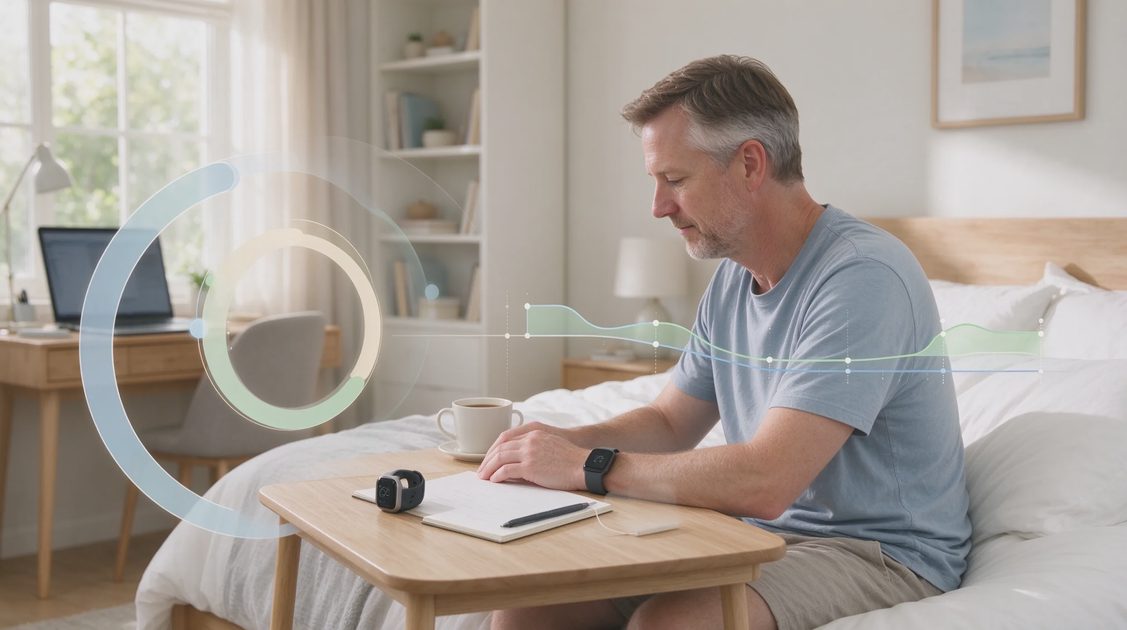
Choose a consistent time that already has a bit of quiet. Sunday evening or Monday morning works for many people. Put it on the calendar if needed so it does not rely on memory. The review itself should take ten to fifteen minutes, not an hour of deep analysis.
Start with your own memory, not the app
Before opening the app, write three quick notes from memory: a rough sense of how rested you felt across the week (good / mixed / low), any obvious life factors (travel, deadlines, illness, late nights, heat), and one thing you already know helped or hindered sleep. These notes anchor the review in lived experience first. The data then becomes a second opinion rather than the primary story.
Look for broad strokes, not perfect percentages
Open the weekly view or scroll through the past seven days with specific questions in mind: Is total sleep time roughly consistent, or is there a clear drift? Do any nights stand out as significantly shorter or more restless, and do those nights match something you already remember? Is there a pattern tied to particular days of the week? Does the overall picture match the energy and mood you actually experienced?
A simple three-column table keeps it practical
Create three columns: Date range, Subjective energy (1-5 average), Device total sleep or score range. Filling it in once a week takes almost no time and makes patterns obvious over a month. You are looking for consistency of timing and total sleep more than precise deep-sleep percentages on any single night.
Interpreting Patterns Without Turning Them Into Pressure
When a pattern appears, respond with curiosity rather than alarm. A week of shorter sleep during a project deadline is information, not failure. It tells you that the current load is costing rest.
Choose at most one small adjustment
You can decide whether to protect bedtime more carefully next week, adjust expectations for energy, or simply accept that this particular week was demanding and move on. Avoid the trap of trying to fix everything at once. Choose at most one small adjustment—an earlier wind-down alarm, a cooler bedroom, or a hard stop on work screens after a certain hour. Implement it for the coming week and review again.
What you can safely ignore
Daily stage breakdowns, exact minute counts, and single-night scores can usually be ignored in the weekly review. They add precision that the underlying measurement does not fully support. Focusing on them recreates the daily anxiety at a slightly larger scale. Stick to totals, timing consistency, and the match with how you felt. That is enough.
Skip the comparison trap
Also ignore any urge to compare your numbers with online averages or with friends. Sleep need varies. Life context varies. The only comparison that matters is whether your sleep is supporting the life you are actually living.
Making the Habit Light Enough to Last
The weekly review works only if it remains light. If it starts to feel like another performance metric, simplify further. Some people eventually move to a biweekly glance or to checking only when they notice a stretch of low energy.
The principle stays the same
The principle stays the same: data is consulted in service of life, not the other way around. I still wear a tracker most nights. I almost never open the app before mid-morning, and I do a structured weekly look only when something feels off or when I am experimenting with a change. The rest of the time the device records quietly in the background.
You can keep the benefits without the daily tax
That arrangement gives me the option of insight without the daily emotional tax. You can have the benefits of measurement without letting measurement run the morning. A calm weekly review is one of the simplest ways to get there. Look for patterns. Trust the match with your own experience. Make at most one small adjustment. Then close the app and return to the life the data was supposed to support.
Let the data inform you, not run you. Once a week is often enough.

Letters
No letters yet — be the first to write.